What is Fiber Optics?
We're used to the idea of information traveling in different ways.
When we speak into a landline telephone,
a wire cable carries the
sounds from our voice into a socket in the wall, where another cable
takes it to the local telephone exchange. cellphones work a different
way they send and receive information using invisible radio waves a
technology called wireless because it uses no cables. Fiber optics
works a third way. It sends information coded in a beam
of light down a glass or plastic pipe. It was originally developed
for endoscopes in
the 1950s to help doctors see inside the human body without having to
cut it open first. In the 1960s, engineers found a way of using the
same technology to transmit telephone calls at the speed of light
(186,000 miles or 300,000 km per second)..

optical fiber construction
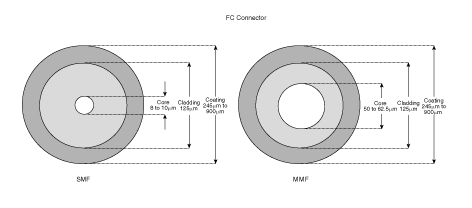
Optical fiber is made by there main layers called
1- core
2-clading
3-coating
1- The core is the highly refractive
central region of an optical fiber through which light is transmitted. The
standard telecommunications core diameter in use with SMF(single mode fiber) is between 8 um and 10 um, whereas the standard core diameter in use with MMF(multi mode fiber) is
between 50 um and 62.5 um.
2- The diameter of the cladding surrounding each of these cores
is 125 um. Core sizes of 85 um and 100 um were used in early applications, but are not typically used
today. The core and cladding are manufactured together as a single solid
component of glass with slightly different compositions and refractive indices.
3- The third section of an optical fiber is the outer protective coating known as
the coating. The coating is typically an ultraviolet (UV) light-cured
acrylate applied during the manufacturing process to provide physical and
environmental protection for the fiber. The buffer coating could also be
constructed out of one or more layers of polymer, nonporous hard elastomers or
high-performance PVC materials. The coating does not have any optical
properties that might affect the propagation of light within the fiber-optic
cable. During the installation process, this coating is stripped away from the
cladding to allow proper termination to an optical transmission system. The
coating size can vary, but the standard sizes are 250 um.
Types of optical fiber
Optical fibers carry light signals down them in what are called modes. That sounds technical but it just means different ways of traveling a mode is simply the path that a light beam follows down the fiber. One mode is to go straight down the middle of the fiber. Another is to bounce down the fiber at a shallow angle. Other modes involve bouncing down the fiber at other angles, more or less steep.Single Mode
The simplest type of optical fiber is called single-mode. It has a very thin core about 5-10 microns (millionths of a meter) in diameter. In a single-mode fiber, all signals travel straight down the middle without bouncing off the edges (red line in diagram). Cable TV, Internet, and telephone signals are generally carried by single-mode fibers, wrapped together into a huge bundle. Cables like this can send information over 100 km (60 miles). Multi Mode
 Another type of fiber-optic cable is called multi-mode. Each optical fiber in a multi-mode cable is about 10 times bigger than one in a single-mode cable. This means light beams can travel through the core by following a variety of different paths (purple, green, and blue lines)—in other words, in multiple different modes. Multi-mode cables can send information only over relatively short distances and are used (among other things) to link computer networks together.
special-purpose fiber
Some special-purpose optical fiber is constructed with a non-cylindrical core and/or cladding layer, usually with an elliptical or rectangular cross-section. These include polarization-maintaining fiber and fiber designed to suppress whispering gallery mode propagation. Polarization-maintaining fiber is a unique type of fiber that is commonly used in fiber optic sensors due to its ability to maintain the polarization of the light inserted into it.
Photonic-crystal fiber is made with a regular pattern of index variation (often in the form of cylindrical holes that run along the length of the fiber). Such fiber uses diffraction effects instead of or in addition to total internal reflection, to confine light to the fiber's core. The properties of the fiber can be tailored to a wide variety of applications
Color Coding or Numbering System of Fibers
Optical fiber are terminated using an industry standard color code.
For optical fibers that consist of more than 12 strands, the color code repeats itself. Each group of 12 strands. color scheme are mentioned below. the same color scheme is for buffer tubes (buffer tube we will discuss in cable section)

